Artists Clementine Keith-Roach and Christopher Page have transformed a Roman gallery into an immersive art bar that blurs boundaries between architecture, social space, and sculpture. Their installation, titled Bar Far, reimagines the new location of Villa Lontana as a visually mesmerizing meeting spot that challenges conventional exhibition formats. The name itself plays on the gallery's name, which translates to 'faraway villa,' positioning the installation as both destination and experience. Running through March 14 in Rome, the project celebrates the legacy of historic art bars while creating a contemporary space for communal engagement and artistic dialogue.
The installation draws explicit inspiration from legendary artistic gathering places, including Zurich's Cabaret Voltaire, the birthplace of Dada in 1916, and Rome's 18th-century Caffè Greco, where Giorgio de Chirico and literary giants like Keats and Byron once congregated. Bar Far extends Keith-Roach and Page's previous collaboration on Bar Moi, further developing their investigation into how social spaces can function as living artworks. From a neon sign on the facade to tables supported by sculpted legs and sconces shaped as hands holding candles, every element contributes to an environment the gallery describes as simultaneously 'church and tomb, prophecy and ruin, heaven and hell.'
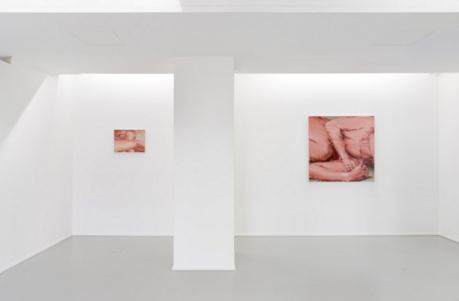
Keith-Roach, known for her figurative sculptures in plaster and terracotta, has hybridized her anatomical forms into functional furniture throughout the space. Her characteristic reliefs and life-size body parts—feet, hands, and other anatomical elements—merge with architectural features, twisting around corners and leading visitors toward the rear arcade. These forms, often displayed as if recently excavated from archaeological sites, create a sense of discovery within the contemporary setting. The sculptures serve as tables, benches, and frames, dissolving the boundary between art object and utilitarian design while maintaining her signature aesthetic of ancient and modern fusion.
Page's contributions create atmospheric depth through his signature trompe-l'œil paintings that function as luminous portals. His red-orange sky paintings, visible beyond a series of arches that echo Renaissance architecture, give the impression that the room floats in air or opens directly into the atmosphere. These works, often framed like windows or mirrors reflecting sunlit corners, add a metaphysical layer to the interior. The combination of ancient Roman and Baroque lavishness with contemporary austerity creates temporal dislocation, where flashes of futuristic color emerge from historically resonant forms, making the past and future coexist in the present moment.
The installation's extensive material list reveals its hybrid nature: cement binder, plaster, gauze, wood, steel, wire mesh, silicone glue, epoxy putty, polymer filler, screws, dowels, acrylic paint, varnish, stucco, neon sign, candles, glasses, and matches. This inventory underscores how Bar Far operates as both sculpture and functional social space. Visitors can actually sit at the tables, rest on the benches, and presumably enjoy refreshments, making them participants in the artwork rather than mere observers. This activation of space connects to a broader tradition of social practice art while maintaining strong formal and material concerns that resist mere theatricality.
Bar Far represents a growing trend in contemporary art where exhibition spaces become immersive environments rather than neutral white cubes. By referencing historical art bars while creating a new iteration, Keith-Roach and Page insert themselves into a lineage of artistic social spaces while proposing new possibilities for how galleries function in the 21st century. The installation's Rome location adds another layer of meaning, engaging with the city's deep history of public spaces as sites of artistic and intellectual exchange. As the art world continues to question traditional exhibition models, Bar Far offers a compelling alternative that prioritizes atmosphere, interaction, and architectural integration over detached viewing, suggesting that the future of art may lie in spaces that bring people together in unexpected ways.