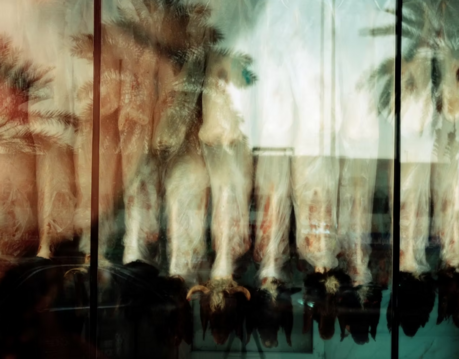
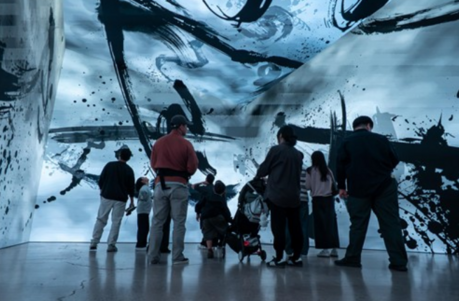
Alejandro Cartagena hasn't touched a camera in six years, the Dominican Republic-born Mexican photographer told a somewhat surprised audience at the opening of his photography exhibition "Ground Rules" at the San Francisco Museum of Modern Art (SFMOMA). The show, which runs until April 19, marks a dramatic shift in the artist's practice as he has turned his attention to an entirely new art form: artificial intelligence. When Cartagena shared this revelation with the gathered crowd, some audience members visibly reacted with discomfort.
Cartagena's photographic journey began in the early 2000s when he started documenting everyday life around his family home in Juarez, which was then a small border town. At that time, artificial intelligence was still in its early stages, and social media was limited primarily to MySpace, long before the explosion of iPhone photography that would later flood digital platforms. His work initially focused on capturing the world immediately around him as Mexico underwent significant changes.
The photographer's career coincided with an ambitious Mexican government initiative to construct hundreds of housing developments across the country. These new suburban communities were designed to provide affordable housing for Mexico's working class, but they ultimately became financial burdens for homeowners who couldn't afford to maintain their properties or sell them. As years passed, residents found their loans growing larger while their quality of life steadily declined. Behind the facade of seemingly perfect cookie-cutter homes lay serious construction flaws that resulted in houses catching fire, lack of running water, and rapid deterioration.
Cartagena's early photographs of Juarez present idyllic family portraits set against backgrounds of sprawling, nearly identical cube-shaped homes. However, his later work captures Mexico's dramatic transformation as the city experienced explosive growth. Over the following decade, Juarez expanded rapidly from a town of 60,000 residents to a bustling metropolis of more than half a million people, with infrastructure struggling to keep pace with the population boom.
As time progressed, the once-pristine homes began showing signs of distress and chaos. One series of Cartagena's photographs and news footage stills documents rows of houses completely destroyed by hurricanes. Another series shows homes being overtaken by vegetation, while some images capture nothing but piles of ash remaining after faulty electrical wiring caused houses to burst into flames. For Cartagena, photography initially served as a tool to understand his home and the rapid changes occurring before his eyes.
The artist's work skillfully interwove scenes of urban development with intimate everyday portraits - workers crowded into truck beds, families gathered around kitchen tables, and children in their bedrooms. His mastery of light transformed potentially harsh scenes of border walls and weary travelers enduring hours-long commutes on overcrowded buses into images of striking beauty. However, this aesthetic approach eventually became problematic for the artist.
By 2016, Cartagena felt increasingly uncomfortable with his photographic practice and abruptly abandoned documentary photography entirely. "I felt like I was romanticizing northern Mexico," he explained to the audience. This realization led him to begin cutting up and manipulating his earlier images rather than creating new traditional photographs. His shift represents a fundamental questioning of photography's role in representing reality.
One of Cartagena's current installations, "Latent Space" (2025), demonstrates his new AI-focused approach. In this piece, he feeds six images of suburban homes built during Mexico's housing program into an artificial intelligence model. Participants use construction paper and move the materials under a camera to generate images of new homes that appear on a large screen. The resulting images bear similarity to Cartagena's original photographs of the homes from years earlier, but with eerily surprising modifications.
These AI-generated images produce unexpected elements that Cartagena never originally captured, including people he has never photographed before standing in front of their new homes, and mysterious writing that appears on walls. For Cartagena, these AI manipulations serve as tools to deepen his understanding of the world around him. "There's a debris of photography," Cartagena observed. "Everyone has a photographic practice." With countless photographs already in existence, he expressed interest in exploring "what the machine can see."
Another installation, "Suburban Bus," showcases Cartagena's algorithmic approach to organizing his vast archive. He fed 3,600 images he had taken of people during their daily commutes in Juarez into an algorithm that read the timestamp of each photograph and arranged them in chronological order. The final result is a massive floor-to-ceiling mural composed of thousands of tiny images showing commuters crowded together for hours, gazing out at urban street scenes as the sun sets.
Cartagena's current practice involves weaving together his own updated work with images from strangers, including stills from broadcast news, newspaper clippings, and family photographs he has purchased at flea markets, often enhanced through technological tools. He views this approach as a new art form and an improvement upon the documentary photography he once loved. His work raises fundamental questions about the role of human creativity in an age of machine capability.
During the question-and-answer period following his presentation, some audience members challenged his approach. One bold attendee asked whether Cartagena, like Andy Warhol, aspired to become a machine. Cartagena laughed and responded, "I am not a machine. Perhaps I'm a bit obsessive though." He then posed a provocative question to the audience: "What is the point of art if a machine can do something that looks like art?" This question encapsulates the central tension in contemporary art as artificial intelligence capabilities continue to expand.