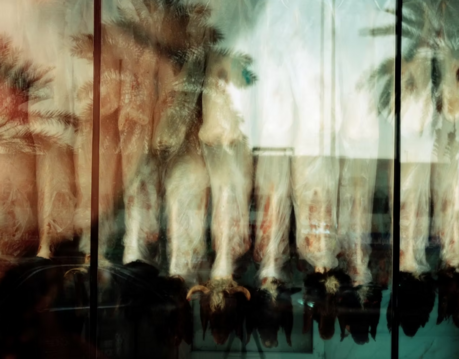
A thought provoking photography exhibition titled "Helvètes migrants" (Migrant Helvetians) is currently on display at the Roman Museum of Avenches in the canton of Vaud, Switzerland, offering a contemporary visual exploration of a pivotal moment in ancient history. The show, which runs through January 25, 2026, documents the failed migration attempt of the Helvetii tribe in 58 BCE through the lens of Neuchâtel based photographer Yves André. This historical episode, famously recorded by Julius Caesar in his "Commentaries on the Gallic War," marks the moment when the Swiss Plateau and its inhabitants were thrust into the annals of recorded history. André's work connects this ancient journey to modern migration issues, using landscape photography to trace the path the Helvetii might have taken across what is now modern day France.
The Helvetii's attempted mass migration was born from desperation and fear. According to Caesar's accounts, the tribe found their territory increasingly cramped and vulnerable to Germanic invasions from the north. In response, they organized a massive exodus, aiming to relocate from their homeland near present day Switzerland to the Atlantic coast of southwestern France, specifically the Saintonge region located between the Charente and Garonne rivers. The project began when André made a personal discovery in Autun, Burgundy, that sparked his interest in this ancient journey. A subsequent conversation with Gilbert Kaenel, then director of the Archaeological Museum of Lausanne, helped crystallize the concept. As someone deeply engaged with the challenges facing contemporary migrants, André found powerful parallels in this two thousand year old story of displacement and survival.
To document the route, André embarked on an extensive research process that involved months of meticulous map study to determine the most probable path the Helvetii would have taken. "I spent several months on the maps trying to understand how they had passed," André explained in a January 2 interview on the program Vertigo. Although concrete details about the exact itinerary remain scarce, he managed to chart a plausible course from Avenches all the way to Saintonge. Rather than traveling on foot as he initially hoped, André retraced the journey by motorcycle, stopping at locations that would have hosted Celtic and Gaulish settlements during the Iron Age. His fieldwork focused on identifying landscapes that have remained relatively unchanged since the time of the Helvetii, creating a visual bridge between past and present.
André's artistic approach distinguishes this exhibition through its deliberate technical and conceptual choices. He used a medium format camera equipped with a tilt shift lens, a tool favored in architectural photography for its ability to control perspective and focal plane. For each location, he captured two distinct views: one representing the ancient landscape as the Helvetii might have experienced it, and another showing the same scene in its contemporary state. The photographs documenting the outbound journey are presented in color, reflecting the photographer's observation that many of these landscapes have changed little since antiquity. In contrast, the images depicting the Helvetii's supposed arrival point are formatted vertically, while the return journey is rendered entirely in black and white, symbolizing the nostalgia and crushing loss of hope experienced by a people forced to turn back.
The exhibition invites visitors to reflect on the universal themes of population movement and migration through the silent testimony of landscapes. By walking the line between historical documentation and artistic interpretation, André creates a dialogue between ancient and modern experiences of displacement. His work suggests that while the specifics may change, the human impulse to seek safety and opportunity across vast distances remains constant. "Helvètes migrants" serves not only as a historical investigation but also as a meditation on how geography shapes human destiny. The show at the Roman Museum of Avenches provides a unique opportunity to consider Switzerland's ancient past while contemplating the ongoing migration challenges facing Europe and the world today.