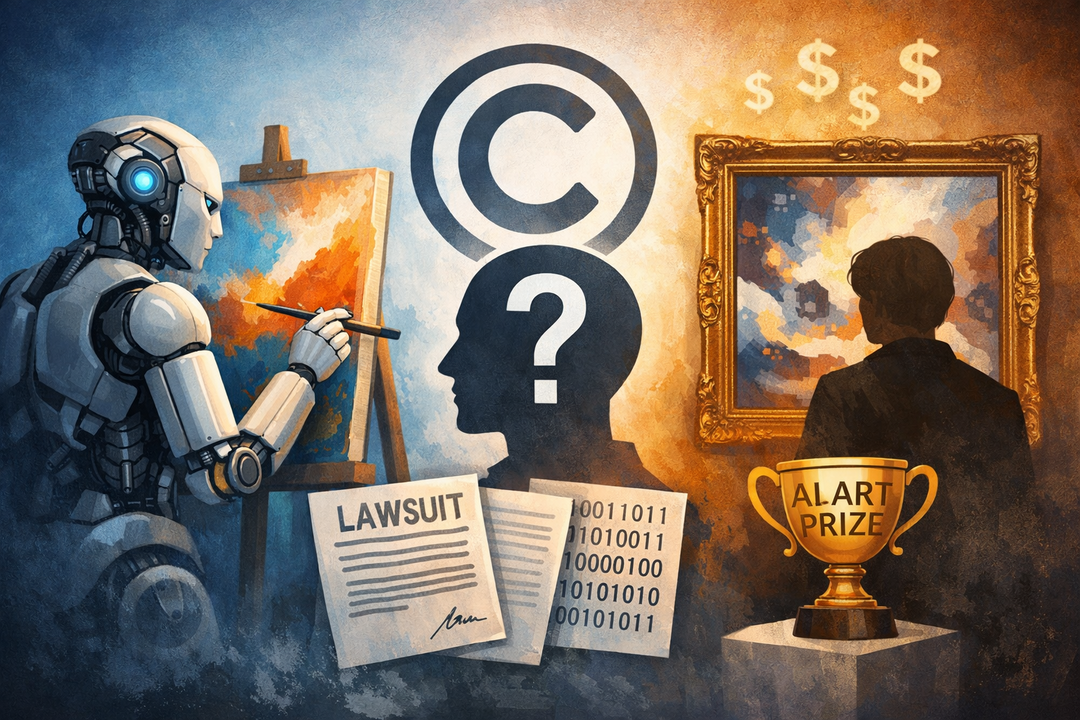
A digital image wins an art prize. A generative soundtrack is shortlisted for a contemporary music award. A collector purchases an AI-assisted canvas at auction. Each event is celebrated as innovation — and condemned as theft.
Across the global art world, artificial intelligence is no longer an experimental tool at the margins. It is entering galleries, fairs and competitions at speed. But with that acceleration comes a mounting legitimacy crisis: Who is the author? Who holds the copyright? And what, exactly, is being rewarded?
From Tool to “Co-Creator”
Artists have always used tools — from camera obscura to Photoshop. Proponents of AI art argue that generative systems are simply the latest extension of that lineage. The human selects prompts, curates outputs, edits iterations and ultimately decides what to exhibit. In that view, AI is a sophisticated brush.
Yet critics point out a crucial difference. Unlike traditional tools, generative AI systems are trained on vast datasets scraped from the internet — often without the consent of the original creators. Painters, illustrators and photographers have discovered that their works were ingested into training models that now produce derivative images in seconds. The legal framework lags far behind the technology.
Several lawsuits in the United States and Europe challenge whether training AI on copyrighted images constitutes infringement. Courts have yet to deliver definitive answers. Meanwhile, art institutions continue to accept AI-assisted submissions, often without requiring clear disclosure of how the work was produced.
The result is a gray zone where recognition may outpace regulation.
The Prize Problem
The controversy intensifies when AI-generated works win awards. In traditional art competitions, the prize affirms individual skill, vision and labor. But if the underlying visual language has been statistically synthesized from thousands of uncredited artists, does the accolade obscure collective, unacknowledged input?
Some competitions have responded by creating separate AI categories. Others have introduced disclosure requirements. Yet many institutions lack consistent policies. The art world — typically cautious and theory-driven — is now reacting case by case, rather than shaping a coherent standard.
The deeper issue is not whether AI art should exist. It already does. The question is whether current systems of validation — prizes, grants, acquisitions — are equipped to assess it fairly.
Economic Displacement and Ethical Friction
Beyond authorship lies economic anxiety. Commercial illustrators report clients replacing commissioned work with AI outputs. Entry-level creative jobs are particularly vulnerable. While established artists may integrate AI into hybrid practices, emerging practitioners face shrinking opportunities.
Ethically, the debate also touches on transparency. If collectors purchase an artwork labeled under a single human name, but the imagery was largely machine-generated, what are they buying — concept, curation or code?
Museums and galleries now confront reputational risk. Embracing AI too quickly may alienate artists concerned about exploitation. Rejecting it outright risks appearing technologically regressive.
A Regulatory Vacuum
Governments worldwide are scrambling to define AI governance. The European Union’s AI Act addresses safety and accountability but leaves artistic authorship largely unresolved. Copyright offices in multiple countries have ruled that works produced solely by AI cannot be copyrighted — yet the boundary between “solely” and “assisted” remains ambiguous.
Without clearer standards, institutions may default to market logic: if collectors buy it, it is art. But markets rarely settle ethical questions on their own.
Beyond Panic, Toward Policy
The art world has weathered technological disruption before. Photography once threatened painting. Digital art once challenged object-based collecting. Over time, institutions adapted, expanding definitions without abandoning critical scrutiny.
AI demands a similarly deliberate response. At minimum, three measures seem urgent: mandatory disclosure of AI involvement, clearer copyright guidelines on training data, and updated competition criteria distinguishing human-led conceptual authorship from automated generation.
The stakes extend beyond aesthetics. Art is not only a commodity; it is a record of human imagination. If creative labor becomes invisible within algorithmic systems, the cultural economy risks eroding trust.
Artificial intelligence will remain part of artistic production. The real test is whether the art world can establish norms that protect creators while encouraging experimentation. Until then, each AI-generated prize or sale will reopen the same unresolved question:
In the age of algorithms, who truly creates — and who gets credit?
SayArt.net
Jason Yim yimjongho1969@gmail.com