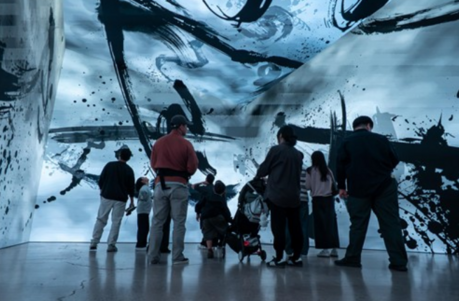
A landmark exhibition exploring the deep historical connections between Southeast Asia and Latin America officially opened in Mexico City on December 4, 2024, inaugurated by Singapore President Tharman Shanmugaratnam during a milestone state visit. The exhibition, titled "Somos Pacifico" (We Are The Pacific), represents the farthest that exhibitions from Singapore have ever traveled and marks a significant cultural milestone as both nations celebrate 50 years of diplomatic relations.
The comprehensive exhibition, housed at the prestigious Colegio de San Ildefonso in Mexico City's historic old town - the birthplace of Mexico's world-famous Muralist movement - features over 300 objects, with approximately 80 pieces drawn from Singapore's national collection. Building on two successful 2023 exhibitions by the Asian Civilisations Museum (ACM) and National Gallery Singapore (NGS), the show fundamentally reorients perspectives on global history by shifting focus away from Europe and highlighting the colonial trade route between Acapulco, Mexico, and Manila, Philippines, from 1565 to 1815.
Mexico's Ambassador to Singapore, Agustin Garcia-Lopez Loaeza, who served as a vocal advocate for the exhibition, emphasized its profound significance during a media preview. Speaking in Spanish, he declared, "All of us are the result of the Acapulco-Manila galleon trade. It's an axis in our identities." The ambassador further stressed the importance of cultural diplomacy, stating, "I've always believed that diplomacy, especially for Mexico, can only work if culture is part of the equation."
The exhibition's timing coincides with a major diplomatic announcement: Singapore will open its first embassy in the Spanish-speaking world in Mexico in 2026, marking only the Republic's second diplomatic mission in Latin America after Brazil. This development underscores the growing importance of Singapore-Mexico relations and the broader connections between Asia and the Americas.
The majority of the exhibition builds upon ACM director Clement Onn's acclaimed 2023 exhibition "Manila Galleon: From Asia To The Americas," which examined the lasting influence of trans-Pacific colonial trade - effectively the first wave of globalization. Curators emphasize the autonomous roles that both Acapulco and Manila played in driving this transformative trade, despite being nominally under Spanish imperial control. The trade brought silver, pineapples, chocolate, and chili to Asia in exchange for spices, silk, and porcelain.
The exhibition showcases remarkable examples of cultural syncretism resulting from this historic trade. Visitors can observe Mexican and Spanish silver coins rebranded by Chinese merchants, ivory Christian statues crafted in the style of Buddha, and one of the show's centerpieces - a portable cabinet-cum-writing desk made in Asia, likely for someone in Mexico or Spain, featuring Chinese guardian lions at its base alongside ornate illustrations of the pre-Hispanic Aztec foundation myth.
National Gallery Singapore extends the narrative into the 20th and 21st centuries through artworks featured in their memorable 2023 exhibition "Tropical: Stories From Southeast Asia And Latin America." Curators Teo Hui Min and Cheng Jia Yun seized the opportunity to introduce Southeast Asian artists to a wider international audience, particularly highlighting the mysteriously pulsating Pago Pago series by Malaysian artist Latiff Mohidin.
Mohidin's work exemplifies the continued cultural connections between the regions. The artist traveled extensively throughout his lifetime, attempting to distill the spirit of Southeast Asia while simultaneously drawing inspiration from Mexican modernism. Curators have connected the two territories through Mohidin's concept of "tropika" - a climactic consciousness where things thrum with life and rapidly decay from heat and humidity.
The contemporary art section features an impressive roster of artists from both regions, including Singapore's Cheong Soo Pieng, Indonesia's Hendra Gunawan, Thailand's Apichatpong Weerasethakul, and the Philippines' Carlos Botong Francisco, displayed in meaningful dialogue with works by Mexican masters Diego Rivera and Miguel Covarrubias. This artistic conversation demonstrates how the historical connections forged centuries ago continue to resonate in modern creative expression.
A distinguished Singapore delegation attended the milestone event, including President Tharman and his wife Jane Ittogi, Acting Minister for Culture, Community and Youth David Neo, Minister of State for National Development and Trade and Industry Alvin Tan, Members of Parliament Ang Wei Neng and Mariam Jaafar, and various political and business representatives. Their presence underscored the significance of this cultural initiative in strengthening bilateral ties.
ACM director Clement Onn highlighted an intriguing historical parallel that adds deeper significance to the exhibition: "The Acapulco-Manila galleon trade ended in 1815. Then Singapore and the Straits Settlements rose in global significance in 1819. This was no coincidence." This observation suggests that Singapore's emergence as a major trading hub was directly connected to the conclusion of the trans-Pacific galleon trade, representing a shift in global commercial patterns that continues to influence international relations today.