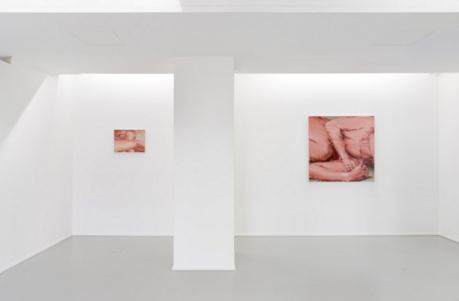
A groundbreaking new exhibition opening this week at the Museum of Modern Art in New York examines how contemporary artists use the female form to express narratives of resilience, survival, and endurance. The show, titled 'Painting Endurance With the Female Form,' brings together more than 50 works from 25 international artists, spanning three decades of artistic production. Curators say the exhibition is the first major museum survey to specifically investigate how painters have reimagined the female body not as an object of beauty or desire, but as a powerful symbol of persistence and strength.
The exhibition opens with a powerful series of large-scale canvases by Mexican artist Elena Vasquez, whose work depicts women performing daily labor in bold, expressive brushstrokes. Vasquez's paintings show female figures carrying water, working in fields, and caring for children, their bodies rendered in earth tones that emphasize their connection to the land. In her artist statement, Vasquez explains that she paints 'the invisible work that women have always done, the weight they carry that society chooses not to see.' The curators have placed these works alongside pieces by African American painter Jordan Williams, whose series 'Mothers of the Movement' portrays women who have lost children to violence, their bodies depicted as monuments of grief and fortitude.
Moving through the galleries, visitors encounter works that challenge traditional representations of the female nude. Instead of passive figures in classical poses, these paintings show women in motion, under strain, and in moments of transformation. French artist Marie Dubois contributes a triptych showing a female athlete at the moment of exhaustion and triumph, while Korean painter Soo-Jin Park's abstract works use fragmented female forms to explore the psychological endurance of immigrants. The exhibition also includes several pieces by Indigenous Australian artist Yirrmal Marika, whose paintings incorporate traditional dot techniques to tell stories of women maintaining cultural practices despite colonization.
The curatorial team, led by Dr. Sarah Mitchell, spent three years researching and organizing the exhibition. Mitchell notes that the project began after she noticed a recurring theme in contemporary painting: artists were increasingly using the female body to talk about social and political endurance. 'We saw artists responding to issues like climate change, migration, gender-based violence, and economic inequality through the lens of female experience,' Mitchell explains. 'The body became a site where these larger struggles could be made visible and visceral.' The exhibition includes a timeline connecting the artworks to major social movements, from the 1990s global women's rights conferences to recent #MeToo protests.
Critical response to the exhibition has been overwhelmingly positive, with the New York Times calling it 'a necessary corrective to centuries of male-dominated figurative painting.' Art critic Robert Chen praised the show's diversity, noting that it includes artists from 18 different countries and features works ranging from hyperrealistic portraits to completely abstract compositions. However, some reviewers have questioned whether the exhibition's narrow focus on painting limits its scope, suggesting that sculpture and performance art might have added additional dimensions to the endurance theme. Museum officials report that advance ticket sales have exceeded expectations, with several sold-out weekends already scheduled.
The exhibition will run for four months and includes an extensive public program of artist talks, panel discussions, and workshops for young artists. A fully illustrated catalog features essays by leading feminist art historians and interviews with all participating artists. The museum has also partnered with local women's organizations to offer free admission days and guided tours for survivors of domestic violence. After its New York run, the exhibition will travel to the Tate Modern in London and the National Museum of Women in the Arts in Washington, D.C., continuing its mission to highlight how contemporary painting can illuminate the universal yet deeply personal experiences of endurance embodied in the female form.