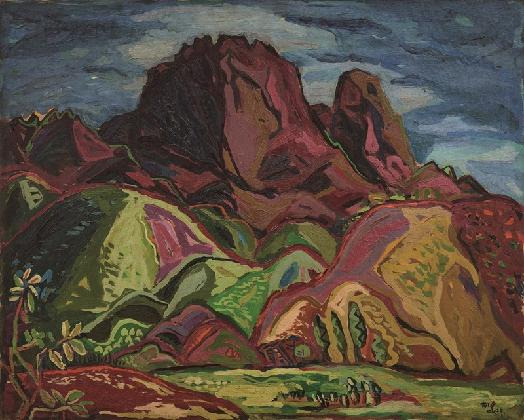
The National Museum of Modern and Contemporary Art, Korea is presenting a retrospective spanning nearly seven decades of work by Korean painter Lee Daiwon (1921–2005).
“Lee Daiwon: Nothing Here Makes You Sad” runs through Nov. 8 in all four galleries of MMCA Deoksugung. The first large-scale museum survey devoted to the artist includes around 120 paintings and 100 archival items.
The exhibition title comes from a comment by archaeologist and art historian Kim Wonryong, a longtime friend of Lee, who wrote that the artist’s paintings contained “nothing that makes one sad.”
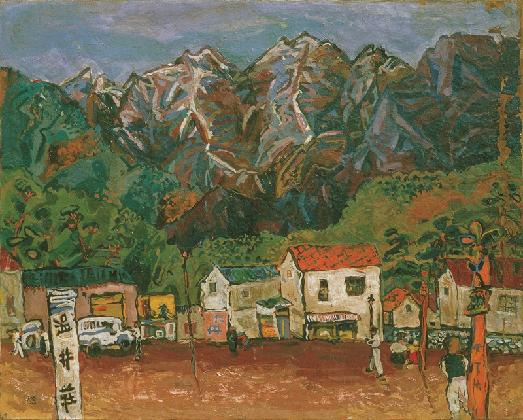
The exhibition moves beyond the conventional interpretation of Lee’s bright landscapes as products of an optimistic disposition. Instead, it examines how his approach to color developed through sustained observation and engagement with Korean crafts and East Asian painting.
Colored embroidery threads, the reflective surfaces of mother-of-pearl inlay, the translucent hues of ox-horn craft and the brushwork of ink painting were transformed in Lee’s work into layered dots, lines and fields of oil paint.
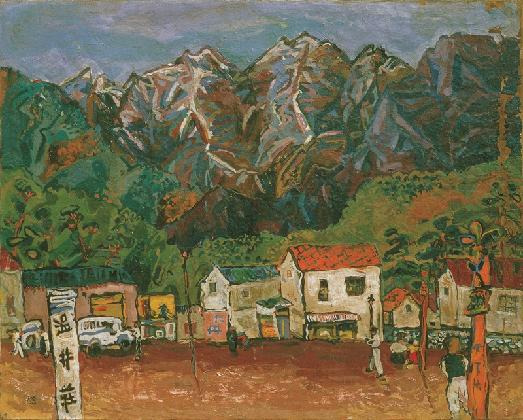
The exhibition is divided into four sections: “Learning Without Confinement,” “Continuing Without Being Swept Away,” “Freedom Through Accumulation” and “Nothing Here Makes You Sad.”
The first section introduces Lee’s early development through a still life completed in 1933, when he was 12, and works made during his school years. A painting by his first art teacher, Japanese painter Sato Kunio, is also being shown in Korea for the first time.
The second section focuses on work from the 1950s through the 1970s. Paintings are presented alongside records from Bando Gallery, which Lee operated, and examples of embroidery, lacquerware, ox-horn craft and wooden furniture from his collection.
The third section examines the period in which Lee established his characteristic use of accumulated colored marks. Paintings from the “Farm,” “Mountain” and “Tree” series show how he repeatedly observed familiar locations and reorganized their forms through color and rhythm.
The final section features large-scale works including “The Wall” from 1986, as well as paintings of orchards, the four seasons and Inwangsan Mountain. Several works extend more than five meters across.
Alongside his painting practice, Lee operated Bando Gallery and served as dean and president of Hongik University and president of the National Academy of Arts. Archival materials document his work in art education, gallery administration and international cultural exchange.
Admission is 2,000 won, excluding the separate 1,000 won entrance fee for Deoksugung Palace.
SayArt.net
Maria Kim sayart2022@gmail.com