SEOUL, June 18, 2026 — BTS did what BTS does. The group filled a stadium, pulled fans from across borders and turned Busan into a citywide celebration. For two nights, on June 12 and 13, the southeastern port city became more than a concert stop. It became a map of K-pop’s global reach.
But the first night also showed something the industry can no longer treat as a footnote.
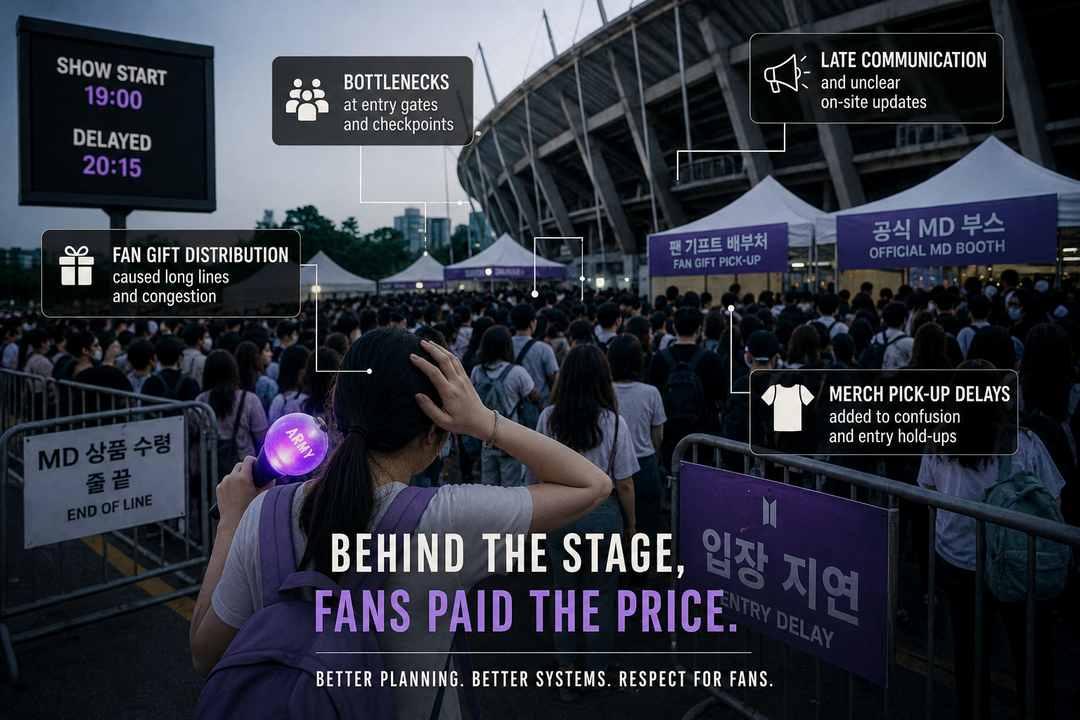
The June 12 concert at Busan Asiad Main Stadium was delayed by more than an hour. HYBE later apologized, citing a combination of on-site communication problems, bottlenecks in fan gift distribution and delays in merchandise pickup. The company also announced additional distribution procedures for fans who did not receive their gifts because of entry delays.
This was not a failure of BTS. It was a failure around BTS.
That distinction matters. Artists perform on stage. Companies build the conditions that allow audiences to get there safely, on time and with basic dignity. When a fan has paid for a ticket, traveled to another city, waited in heat or rain, followed instructions, stood in line and still cannot enter before the scheduled start, the problem is not a minor inconvenience. It is a breach of trust.
K-pop has grown too large to hide behind improvisation.
For years, the industry has celebrated scale. Bigger stadiums. Longer tours. More cities. More languages. More pop-ups. More live streams. More merchandise. More “experiences.” The Busan stop of BTS’s “ARIRANG” tour was designed as exactly that kind of total experience. Under the “BTS THE CITY ARIRANG BUSAN” program, the concert spread across bridges, beaches, shopping districts, transit hubs and cultural landmarks. It was not only a music event. It was a temporary city inside a city.
That ambition is impressive. It is also dangerous if the infrastructure does not match it.
A citywide K-pop event is not just a concert with decorations. It is a mass-movement operation. Fans move through transportation systems, ticket gates, merchandise booths, pop-up stores, photo zones, hotels, restaurants and public spaces. Many are young. Many are foreign visitors. Many follow detailed digital instructions in a language that may not be their own. If one point in the chain fails, the pressure spreads quickly.
The Busan delay exposed that chain.
Fan gifts may sound trivial to outsiders. Merchandise pickup may sound like a retail issue. On-site communication may sound like an internal matter. But at a stadium event, these are crowd-control issues. They affect flow, timing, anxiety and safety. They determine whether tens of thousands of people can move smoothly or become trapped in confusion.
The modern K-pop fan is often asked to do a remarkable amount of administrative labor. Join the platform. Verify the membership. Enter the lottery. Check the notice. Download the app. Find the booth. Scan the code. Pick up the gift. Buy the merchandise. Follow the map. Watch for updates. Stay flexible. Be patient.
Fans do it because they love the artist.
That love should not be treated as an operational cushion.
ARMY is one of the most loyal and organized fandoms in the world. That is precisely why companies must be careful. A strong fandom can absorb mistakes, explain them, defend the artist and try to keep the mood positive. But loyalty is not a substitute for planning. Devotion should not become free crisis management.
HYBE’s apology was necessary. It was also only the beginning. The more important question is what changes before the next stadium fills. Was the entry design reviewed? Were fan gift and merchandise lines separated clearly enough? Were multilingual updates fast enough? Were staff empowered to make decisions on the ground? Was the scheduled start time realistic given the number of required checkpoints?
These are not glamorous questions. They are not the questions fans post fancams about. But they are now central to K-pop’s global future.
There is a broader lesson for South Korea as well. The country has learned how to turn cultural success into urban spectacle. Concerts are now tied to tourism, local branding, transportation, retail and national image. Cities want the economic spillover. Companies want the expanded ecosystem. Fans want memories that begin before the first song and continue after the encore.
That model can work. Busan proved its potential. It also showed its limits.
A K-pop city event cannot be judged only by drone shows, photo zones and sold-out seats. It must also be judged by the line outside the gate. By the clarity of a sign. By the speed of a notice. By whether a foreign fan knows where to go. By whether the last person in line feels seen before the lights go down.
Great pop culture is not only what happens on stage. It is also how people are treated while waiting for the stage to begin.
BTS has carried Korean music to places once unimaginable. The group’s 13th anniversary in Busan should have been remembered only for its emotion, scale and homecoming symbolism. Instead, it will also be remembered as a stress test for the K-pop event machine.
That may not be a bad thing if the industry learns from it.
The next phase of K-pop will not be decided only by songs, choreography or chart rankings. It will be decided by trust. Trust that a ticket means a real experience, not a logistical gamble. Trust that global fans will be welcomed, not merely monetized. Trust that the industry’s backstage systems are as professional as the artists on stage.
BTS deserved that. So did ARMY.
K-pop has already proven that it can move the world emotionally. Now it must prove that it can move crowds responsibly.
SayArt.net
Jason Yim yimjongho1969@gmail.com